
Ryde Architecture
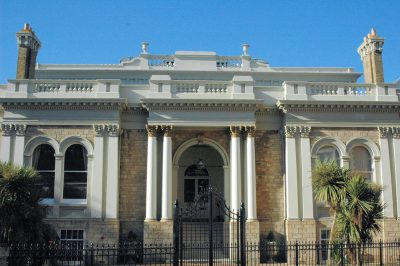
ROYAL VICTORIA YACHT CLUB
(Frontage in St. Thomas Street, Ryde)
The Royal Victoria Yacht Club was formed at Ryde, Isle of Wight on the 24 May 1845, Queen Victoria’s birthday, by a number of enthusiastic yachtsmen who, according to Hunt’s Yachting Magazine, were interested in racing as opposed to cruising, and ‘though so immediately in the vicinity of the Royal Yacht Squadron at Cowes, and the Royal Southern Yacht Club at Southampton, no offence had been intended, as some persons have asserted, towards those distinguished societies.’
Her Majesty the Queen, and His Royal Highness Prince Albert, graciously extended their patronage, and many noblemen and gentlemen became members.
Membership was open to any gentleman the bona-fide owner of a vessel, without limitation of tonnage, or who shall have been a member of the Royal Yacht Squadron, the Royal Western Yacht Club, the Royal Irish Yacht Club, and also the fathers, sons, or brothers of members as above, were eligible to become members.
The Club House: In December 1845 the Commodore announced ‘an agreement with the landed proprietors of Ryde for a plot of ground for the site of their proposed Club House, with right to construct a battery of eight guns similar to that at Cowes Castle’. It was decided to commence building a Club House immediately. To raise the required amount for this building 145 Debentures @ £25 were taken up by members. This raised £3,625. In return interest at £4.4.0. per cent per annum would be paid. In addition, Furniture Debentures raised another £960. (These Furniture Debentures were repaid in full by 1858). The architect was William Huntley of Dover and the builder John Denham of Ryde. The building cost £4,500 and was completed in 1847.
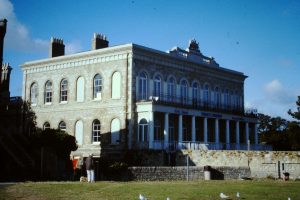
The Seaward side, when used as the Prince Consort
On the 4 June 1845 the Club received Admiralty Warrant for members to fly the Red Ensign of HM Fleet and a red Burgee with crown and anchor in the centre and the letters V and R on either side. The Club was the only body of its kind that started life as a fully-fledged “Royal” Club and known as “The Red Squadron” in contra-distinction to the “White Squadron” of Cowes.
As described in Hayden’s Dictionary of Dates 1902, the best view of the Club-house is obtained from the pier. The building, which is very effective architecturally, has two verandas towards the north, or sea front. The lower of these has a row of pillars, which supports the upper, while the whole is surmounted by a cornice having a round balustrade in the centre bearing the Royal arms. The Club is entered from the south side, from a carriage sweep, the two wings of the building on either hand containing spacious billiard rooms.
Note:
The building was much later used as the “Prince Consort” nightclub, and more recently as luxury apartments.
Sources: RSHG, Hunt’s Yachting Magazine, and Hayden’s Dictionary 1902
Images: RSHG
Article: Ann Barrett