
Quarr Abbey Ruins
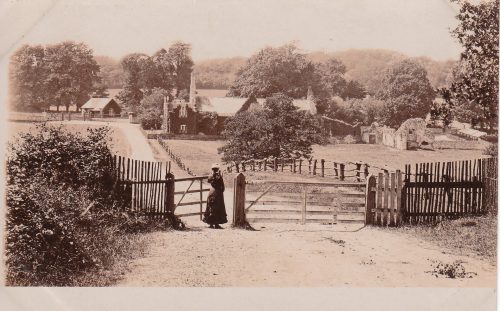
18 March 1905
A lantern Lecture in aid of the funds of the Holy Trinity Church Institute, was given by Mr. F. C. Burton in the Holy Trinity Parish Room, on Tuesday evening last, to a good audience.
Mr. Burton, in his treatment of his subject, “The Ancient Abbey of Quarr,” clearly showed that he had taken more than a passing interest in what had once been a magnificent building, and a centre of help for the poor of the Island.
The lecturer went very completely through the history of the Abbey, noting its peculiarities. Among others he mentioned the image which still appeared built into the old farmhouse at Nineham, and stated that he could himself remember the tenant of that farm reaping the fields at the bottom of Monkton Street, a privilege granted by a former abbot, on condition that the image remained in the building. The name of the street was evidently derived from Monks’ Mead.
Some excellent photographs were shown at the conclusion, which were kindly lent by Mr. F. N. Broderick. The majority of them were views of the excavations, which were made on the site of the Abbey, a few years ago, and among them was the gruesome picture of the remains of what was undoubtedly the founder of Quarr, Baldwin de Redvers, whose bones, as depicted, had been lying in the place of honour in the Church for nearly 800 years.
A good photograph of the visit of General Sir Redvers Buller to Shanklin recently (1905), was shown, the lecturer remarking that there appeared to be some connection of the great General with the founder of the Abbey.
At the close Mr. A. Holt moved a vote of thanks to the lecturer on behalf of the Church Institute, for which a collection realised a good amount.
Note:
The name Quarr supposedly came from the word ‘quarry’ there being originally a stone quarry in the neighbourhood. The title of the early monastery was the Abbey of Our Lady and St John. Stone from the quarry was used in the Middle Ages for both ecclesiastical and military buildings, for example: for parts of the Tower of London.
Source: IW Observer, lecturer F. C. Burton & Wikipedia
Image: Postcard courtesy of Paul Kingswell
Article: Ann Barrett