
Ryde Architecture
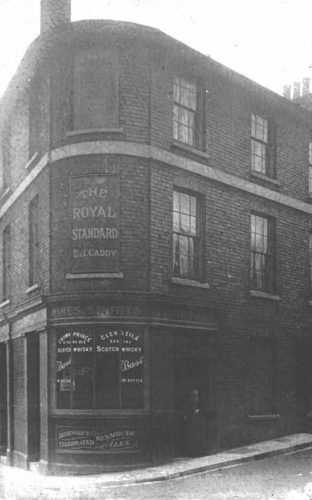
THE ROYAL STANDARD
On the corner of Castle Street and Union Road, Ryde
Ryde Licensing Sessions 11 March 1912
Five licenses of the borough were objected to by the Chief Constable, (Mr. Charles Greenstreet), on account of redundancy. The first objection was the renewal of the license of the Royal Standard, Castle Street, owned by the United Breweries, Ltd., and tenanted by Mrs. Emily Jane Caddy.
Chief Constable Greenstreet said he opposed the license as there were in the borough 87 licensed houses and the population according to the census of 1911, was 10,609. That showed one license to 154 persons. That house in Castle Street, was in an area where there were several licensed houses in the immediate neighbourhood. Its rateable value was £19 nett, and £21.10s. gross. The licensee was a widow. There appeared to be a small amount of working-class trade done at the house. The premises were quite suitable structurally and the house was well conducted.
There was a beer house immediately opposite the Royal Standard. The Greyhound, a fully licensed house, was situated 74 yards to the westward, and to the eastward was the Black Horse, 61 yards distant. Then there was another public house less than 100 yards away. The house in question (the Royal Standard) was in a fair state of repair. There were 11 other licenses registered in the town. The Royal Standard was not needed.
Mrs. Caddy had been the licensee of the Royal Standard for eight years. The licensee let lodgings during the summer. The house was well furnished and was thoroughly respectable.
George Goodwin, employed by the Portsmouth United Breweries, said the Royal Standard belonged to his employers. It was let on the usual tenancy and brewers condition, the rent being £12 per annum. The house consisted of a public bar, a private bar, a smoking room, a bar parlour and living accommodation of the tenant. The landlord did all the repairs. Mrs Caddy was a very satisfactory tenant. His employers had only bought the house 18 months ago.
Emily Caddy, licensee of the Royal Standard, said she let lodgings in the summer which considerably increased her means of livelihood.
The Magistrates retired to consider all the cases that day in private, and on returning, the Mayor announced that the Bench unanimously agreed to refer the Royal Standard and the Royal Sovereign, on account of redundancy, for compensation. The other licenses were renewed.
Note:
Opened in 1852, Mr Henry Kemp was for many years the licensee and tenant of the Royal Standard, prior to that of Mrs Caddy. To read the full report of the five pubs under review that day, see the newspaper IW Observer 16 March 1912, page 7.
Sources: IW Observer & RSHG
Image: courtesy of Tony Gale
Article: Ann Barrett