
Reminiscences of 1896
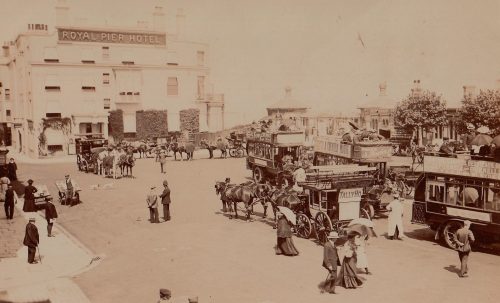
Photo memories of Ryde
Glancing back at old photos in 1956, brought memories of faces and places of 60 years past, to F. A. Rees, a few of which are mentioned below. A very different Ryde than today 2026.
In his boyhood, one side of Well Street was a field. At the top where the Primitive Methodist Church was erected was a row of small cottages below street level: an iron railing was fixed to the pavement to prevent the public from tumbling into the yard below. From Player Street to St. John’s Road Boy’s School were large grounds bounded by a high stone wall in which was situated a big house, this was the residence of Dr. Barrow, nine times mayor of the borough.
The Western Esplanade in 1956, occupied the site of a one-time terrace of boarding-houses. At the bottom of the High Street in St. Thomas’s Square were old-fashioned shops, built high and with bow windows, approached by flights of stone steps. One was a barber’s shop, and it was possible to see the “operations” taking place from outside. Almost all the shops were owned by local tradesmen. Chromium fronts were unknown; all were of plain wood, painted and varnished with the name of the trader on. The shops kept open late into the evening and on Saturdays, some till midnight. When business was over the windows were covered with wooden shutters.
Those were the days of horses and carriages; very few motors had made their appearance. In various parts of the town were carriage builders, and a good number of stables. There were corn merchants, saddlers, and harness makers. Some displayed a horse’s head as a sign.
In the large houses, mostly situated in the Park (St John’s) and the Strand, were hosts of servants, cooks, parlourmaids, coachmen, footmen, and butlers all in uniform, as well as gardeners, quite a little world of their own.
Fashion was different. Women wore very long skirts. Almost all men wore bowler hats on Sundays, and cloth caps in the week. In the summer they wore white “boater” straw hats. Nearly all carried walking sticks on Sundays. The doctors wore high silk hats.
A familiar sight was the milkman with the wooden yoke across his shoulders, from which, attached by two long chains, were large pails of milk. The lamplighter was a well-know figure with his long pole, going his round as it grew dark. The organ grinders were welcomed by the children and brought music to the streets. The cinema had not arrived, so the travelling circus attracted much attention.
Sundays were quieter. There were no public games but most families enjoyed a walk into the countryside. People attended church more regularly; in fact, most churches were well filled. On special occasions, such as Easter and Harvest Festival, every seat was taken some times half an hour before the service.
Such was life before the upheaval of 1914, when the old, peaceful world, with the quieter way of living, passed away for ever.
Source: RSHG, F. A Rees & IW County Press
Image: Roy Brinton Collection
Article: Ann Barrett