
Militia at Puckpool Battery 1892
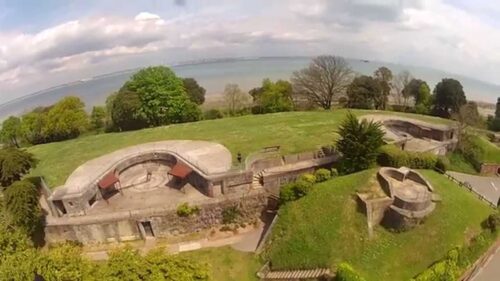
THE HADDINGTON MILITIA ARTILLERY AT PUCKPOOL BATTERY
During June 1892, the inhabitants of Ryde had seen a great deal of the canny Scotsmen who composed the Haddington Artillery Militia, and, on the whole, they had formed a favourable opinion of them. To the Militia a visit so far south would probably been an important and long-remembered event. It seemed, however, that once every five or six years they were brought south in order that they may become acquainted with the big guns and the manner of working with them. They had never been so far south before. To camp out on the banks of the Solent, with an umbrageous shade behind them, the blue sea in front, and a not very long distance to walk to reach a town like Ryde, would have not been otherwise than a pleasant experience.
The writer of this information, was tempted to visit the Puckpool Battery, and found no difficulty in obtaining permission, although hitherto his inspection of those defensive works had been entirely from the outside.
Captain Walker (one of the officers whose courtesy deserved this public acknowledgment) kindly showed him around, and the conclusion borne upon his mind was that the men were as fortunate in their officers as in their surroundings. Colonel Dawson and all the officers appeared to take the greatest pride and interest in their men and to study their comfort in every way.
The piece of ground at the rear of the battery was rather more extensive than possibly many people imagined. At all events there was ample room for the long row of tents which accommodated the 600 men composing the regiment. Each of the tents was, at the time of the visit, thrown open, and the beds and luggage, neatly folded, were ranged around them. Round the centre of each tent pole was a stand which held the arms and accoutrements of the men. Remarking about the small numbers present, the writer was informed that 250 of the men proceeded daily to the Norman Fort for instruction, under Major Saltmarsh, R.A., and Captain Wylie, Regimental Instructor in Gunnery.
Nearly half the regiment were absent, and those left behind were busy cleaning their accoutrements, &c., while others were exercising in loading, sighting, firing and cleaning the 25-ton guns. There was an allotted number of men to each gun. Every man was assigned his particular duty, which seemed to be performed accurately and promptly at the word of command. The work required considerable care, and the non-commissioned officers in charge were evidently men of intelligence.
With a view to render the guns invisible as they peeped through the grass-covered embrasures, some of the guns had been painted green (not a grass, but an emerald green), and it was not at all surprising to learn, that this was rather a mistake, as the guns could be easily spotted from the distant forts. In fact the green guns were more easily distinguished from a distance than those which retained their original hue. A light slate colour or grey was evidently the best.
A number of men not on duty were in the reading tent, writing letters home, or reading the papers of which the officers had taken care to provide a liberal supply. The men had a very comfortable canteen, and the sergeants had a mess tent to themselves. An exceedingly appetising smell was coming from the field kitchen, where, in the open air the cooks were busy preparing dinner, cooking potatoes by the bushel and stew by the hogshead. The cooking was done in the ordinary style, trenches being dug converging to a turf chimney, the tops of the trenches were covered with clay, and over the opening dozens of pots were ranged side by side.
Here and there, distributed among the tents, were the water carts, and the Ryde town water was spoken very well of. The officers’ tents were situated at the west end of the ground, and were distinguished by rather more luxurious surroundings, such as camp bedsteads, drawers, and boarded floors. The officers’ mess consisted of two large tents adjoining, one nicely furnished as a drawing room, and the other as a dining room.
The band of the regiment performed at intervals, under Bandmaster McNie, and it was engaged to give a performance on Ryde Pier on the forthcoming Thursday evening.
The medical profession was represented by a very energetic officer, Surgeon Dunn, who, however, up to that time, had not had much to do.
The officers and men were expecting a sudden attack upon the Isle of Wight, which they would have to meet, but when the enemy would come of course, no one knew.
Note:
Work was in progress at Puckpool Park in April 1970 where former gun emplacements and underground bunkers were being removed to increase car parking space before the summer season commenced. The fort was built in the 19th century to protect the approaches to Portsmouth Harbour.
Source: IW Observer
Image: Part of the remains of Puckpool Battery, Roy Brinton Collection
Article: Ann Barrett