
Ryde Architecture
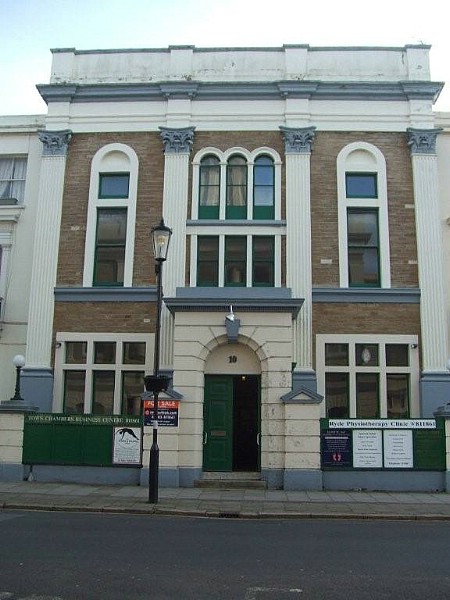
THE VICTORIA ROOMS
This distinctive building on the south side of Lind Street, situated opposite the Town Hall in Ryde, has had many uses over the years, the Town Chambers, Messrs. Way Riddett’s auctions rooms, and a Physiotherapy department, but much before that it was known as the Victoria Rooms. A social centre where people would gather for all manner of events and occasions, there was not very much that didn’t take place at that convenient venue. To show the wide range of activities that took place, a few examples are below.
August 1860 Dr. Mark’s Concerts – On Tuesday evening the Victoria Rooms was crowded with a fashionable audience. The performers were the juvenile group of musicians, who were highly appreciated and much applauded, and their appearance in Rifle costumes added considerably to their popularity. Go so ever he will, we wish Dr. Mark and his cause the most unbounded success.
December 1861 Tea Supper – The parents of the school children of Trinity District Schools were invited by the clergy and district ladies to the annual Christmas tea supper at the Victoria Rooms, on Thursday evening. The Rev. A. J. Wade presided, and the hungry were filled with good things, and none were sent away empty.
July 1862 Wizard-craft – Herr Dobler performed at the Victoria-rooms on Tuesday and Wednesday, the attendance was good. His tricks were elegant and clean, and gave great satisfaction.
March 1866 Working Men’s Club – The eighth night of the penny readings in connection with this club came off at the Victoria-rooms on Monday evening last, when there was a very full attendance.
December 1868 I.W. Rifle Volunteers – There was a large muster of the Volunteers and their friends at the Victoria-rooms on Wednesday evening, for the purpose of presenting the prizes which had been shot for at the Binstead range, on Thursday 22nd October. The corps mustered in Lind-street and headed by the band, had a march out, arriving at the Victoria-rooms at 7 o’clock.
March 1874 On Thursday afternoon last, an entertainment of dissolving views was given at the Victoria-rooms, for the special amusement of the children of the Sunday schools of the town. The views exhibited by Mr. W. Woods, jun., who had succeeded in securing a very powerful set of apparatus which brought out with a clearness and sharpness of outline. The young people present frequently manifested their delight in the usual old English fashion.
September 1874 The novelty and anomaly of being able to enjoy the pleasures of skating with few of its dangers, and in the midst of moderately warm weather, had attracted considerable numbers each day to the skating rink then open at the Victoria-rooms. The floor of the room had been treated in such a way that no inequalities could be perceived, and the skaters glided along in exact imitation of the easy motions of the proficient on the ice.
August 1875 One of the most interesting exhibitions which had been witnessed in the town for a long time was open to the public at the Victoria-rooms. It was that of glass-blowing, it was explained and illustrated by Mr. Woodroffe. The chief object of interest were two steam engines—the one was a vertical low-pressure steam engine, and the other a horizontal high-pressure engine. The peculiarity of these being that they were constructed entirely of glass, which had been blown, by Mr. Woodroffe, not one portion having been moulded or made by machinery. Mrs. Woodroffe at the same time was engaged in the manufacture of a variety of pretty ornamental articles in glass consisting of baskets of fruit, birds, ships and many other things.
February 1876 The Shakers – Mrs. Girling and 12 members of her community visited this town. They had been brought here by Mr. Councillor Knight, and remained for a whole week, and gave seven lectures at the Victoria Rooms, as well as services in the afternoons. There could not have been a better opportunity than that afforded of learning the principles of those people, who called themselves Bible Christians.
Note:
Lind Street was developed in the 1820s and ‘30s and named after Dr John Lind, a physician at the Royal Naval Hospital at Haslar, across the Solent in Gosport. His father’s research into scurvy was an important medical advance. John Lind was one of many men with links to the navy who chose to live in a quieter manner.
Source: IW Observer, RSHG
Image: RSHG
Article: Ann Barrett